
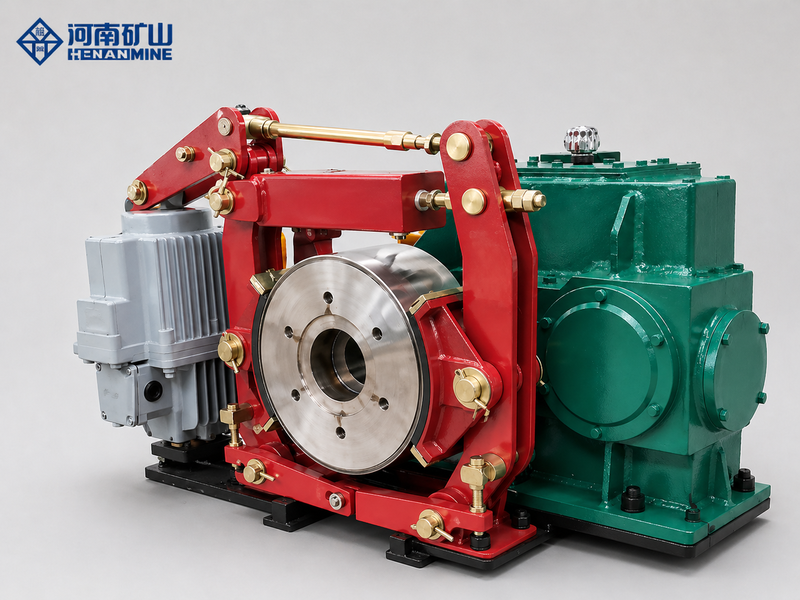


Overhead Crane Brakes
Overhead Crane Brakes are key crane safety components used to stop, hold, and control bridge, trolley, and hoist motions in overhead cranes and gantry cranes.
Product Overview
Overhead Crane Brakes are essential safety components for crane travelling, trolley travelling, and hoisting mechanisms. They are installed to stop movement, hold the load or mechanism in position, and provide reliable braking control during crane operation, maintenance, and emergency conditions.
Crane brakes are commonly used on bridge cranes, gantry cranes, hoists, trolleys, and other power-driven lifting systems. According to the crane structure and working condition, the brake can be selected for service braking, holding braking, or emergency braking. Proper brake selection helps improve operating safety, positioning accuracy, equipment reliability, and long-term crane performance.
Overhead Crane Brakes for Safe Motion Control
Available brake types include thruster drum brakes, thruster disc brakes, and DC magnetic drum brakes. Drum brakes are widely used for general crane mechanisms, disc brakes are suitable for compact and responsive braking arrangements, and magnetic drum brakes can be selected for specific motor-driven crane systems. The final type should be matched with the motor, reducer, shaft arrangement, braking torque, duty cycle, and installation space.
The main brake system can include a brake drum or disc, brake caliper or brake arm, friction lining, actuator, spring system, control unit, and mounting base. In crane applications, these parts work together to reduce motion, hold the mechanism, and prevent uncontrolled movement. For hoisting mechanisms, brake reliability is especially important because it directly affects load holding and lifting safety.
For replacement or new crane design, the correct brake model should be selected according to crane type, mechanism position, motor power, shaft diameter, braking torque, working duty, ambient condition, and control voltage. If the brake is used in dusty, humid, high-frequency, outdoor, or corrosive environments, protection level, lining material, actuator type, and maintenance access should be confirmed before production.
For related lifting equipment, you can also view Overhead Cranes, Gantry Cranes, and Electric Hoists. For crane safety and industry reference, you may check the OSHA Overhead and Gantry Cranes Safety Standard, ASME B30.2 Overhead and Gantry Cranes, and ISO 4301-1 Crane Classification.
Technical Parameters
Technical parameters vary by capacity, span, lifting height and working duty. Contact us with your project data for a matched configuration.
Key Features
Stable structure, smooth operation, flexible control options and project-specific design for industrial lifting applications.
Customized Crane Solution
Crane capacity, span, lifting height, control method, duty class, power supply and installation conditions can be adjusted according to your project requirements.
Get a Factory-Based Quotation
Send your capacity, span, lifting height and working site. Our team will help check the suitable crane type and provide a project-based quotation.
What We Need
- Capacity, span, lifting height and working duty.
- Workshop or yard layout, runway condition and power supply.
- Working environment, daily operation time and special requirements.
- Destination country, quantity and drawings or photos if available.
How It Works
- Send parametersShare the project data you already know.
- Confirm configurationWe check crane type and key technical scope.
- Receive quotationGet factory-based price and selection support.