
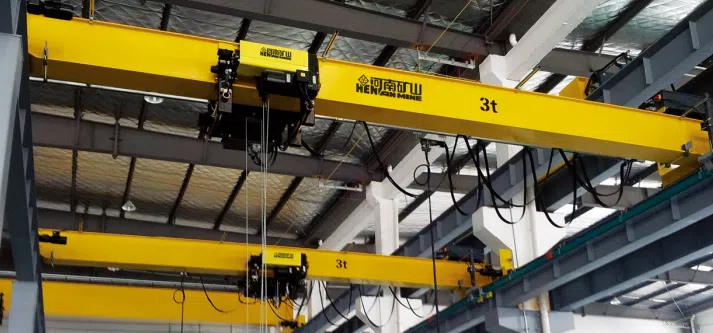
In modern industrial facilities, many workshops and warehouses face a persistent challenge: restricted building headroom paired with growing heavy lifting demands. Standard overhead cranes typically require substantial vertical clearance between the crane girder and roof truss, which eats into usable lifting height and limits operational efficiency — especially in existing low-ceiling facilities.
A low headroom overhead crane is purpose-built to solve this problem. By optimizing the trolley structure and pairing it with a low headroom electric hoist, this compact overhead crane minimizes the required installation space while delivering the maximum possible net lifting height.
As a leading low headroom overhead crane manufacturer, we design solutions widely used in manufacturing plants, machinery workshops, warehouses, automotive assembly lines, steel fabrication yards, and maintenance bays where every millimeter of vertical space directly impacts productivity.
What Is a Low Headroom Overhead Crane?
A low headroom overhead crane (also called a low headroom bridge crane or low clearance overhead crane) is a type of bridge crane engineered with a compact profile to reduce the vertical distance between the runway beam top and the hook's highest lifting point.
Compared with conventional overhead cranes, the low headroom design delivers:
- Higher effective net lifting height under the same roof height
- Lower minimum building height requirement for installation
- Improved overall utilization of workshop vertical space
- Avoidance of costly building reconstruction or roof raising
The core design difference lies in the low headroom hoist trolley arrangement. Instead of hanging entirely below the main girder, the hoist body sits partially beside or above the girder profile, greatly reducing the overall headroom dimension and improving hook approach distance.
Main Components of Low Headroom Overhead Crane
A complete low headroom overhead crane system consists of four core sections:
1. Bridge Girder
The bridge girder is the primary load-bearing structure that spans the workshop and transfers lifting loads to the runway rails.
Based on capacity, span and duty requirements, two configurations are available:
- Single girder low headroom crane: Most cost-effective for capacities up to 20 tons, ideal for light to medium duty applications
- Double girder low headroom crane: For heavier loads (10–50+ tons) and longer spans, offering higher rigidity and better hook approach
2. Low Headroom Electric Hoist

The low headroom electric hoist is the core lifting component that defines the crane's space-saving performance.
Compared with standard CD/MD wire rope hoists, compact hoist trolleys offer:
- Reduced overall installation height
- Higher upper hook limit position
- Smooth lifting and steady load handling
Common hoist configurations include:
- European-style electric wire rope hoist
- Compact monorail trolley hoist
- Low-headroom chain hoist (for light capacity applications)
3. End Carriages (End Trucks)
End carriages are mounted on both ends of the bridge girder and enable the crane to travel along the runway rails.
Each end carriage assembly typically includes:
- Travel motors with brake units
- Gear reducers
- Forged steel crane wheels
- Rubber or polyurethane buffers
- Anti-derailment safety devices
4. Electrical Control System
Control systems are fully customizable to match operational needs:
- Pendant push-button control (wired)
- Wireless radio remote control
- Operator cabin control
- Variable frequency drive (VFD) for all motions
VFD control is recommended for applications requiring precise positioning, smooth acceleration/deceleration, and reduced mechanical impact on both the crane and building structure.
Key Advantages of Low Headroom Overhead Crane
1. Maximized Net Lifting Height
The biggest benefit of a low clearance overhead crane is the increased available hook height. For a typical low-ceiling workshop, this design can add 300–500 mm of extra lifting height compared with a standard overhead crane of the same capacity.
2. Space-Saving Compact Design
A space saving overhead crane requires far less vertical installation clearance, making it the ideal choice for:
- Existing factory buildings with low roof height
- Renovation and upgrade projects
- Warehouses with limited overhead space
- Temporary production facilities
3. Improved Workshop Utilization
By unlocking additional vertical lifting space, factories can:
- Handle taller workpieces and larger equipment
- Stack materials more efficiently
- Expand production capacity without structural modification
- Reduce bottlenecks in material handling processes
4. Cost-Effective Lifting Solution
Compared with raising the workshop roof or constructing a new taller building, installing a compact overhead crane is a far more economical solution with a much shorter return on investment cycle.
Low Headroom Overhead Crane Applications

Low headroom bridge cranes are deployed across a wide range of industries:
Manufacturing Industry
For handling machine components, raw production materials, tooling, and finished goods on assembly and production lines.
Automotive Industry
Used in engine assembly workshops, vehicle maintenance bays, and parts storage areas for component lifting and positioning.
Steel Fabrication Workshops
For lifting steel plates, structural beams, and welded assemblies in fabrication, cutting, and welding stations.
Warehousing & Logistics
For heavy pallet loading/unloading, inventory stacking, and cargo handling in low-clearance warehouses.
Maintenance & Repair Workshops
For disassembly, repair, and reassembly of heavy machinery, engines, and industrial equipment.
Low Headroom Overhead Crane Specifications
Below are standard technical parameters. Custom designs are available to match specific workshop conditions.
| Parameter | Standard Range |
|---|---|
| Lifting Capacity | 1 ton – 50 ton |
| Crane Span | 5 m – 35 m |
| Lifting Height | 3 m – 20 m |
| Working Class | FEM M3–M6 / ISO A3–A5 |
| Power Supply | 380V 50Hz 3 Phase (customizable) |
| Control Method | Pendant / Wireless Remote / Cabin |
Custom engineering is available based on your workshop dimensions, load characteristics, duty cycle, and local industry standards.
Single Girder vs Double Girder Low Headroom Overhead Crane

Choosing the right girder configuration is critical for performance and cost efficiency.
| Feature | Single Girder Low Headroom Crane | Double Girder Low Headroom Crane |
|---|---|---|
| Typical Capacity | 1 – 20 ton | 10 – 50+ ton |
| Headroom Profile | Ultra-compact | Slightly larger than single girder |
| Hook Approach | Good | Excellent (hook rises between girders) |
| Best For | Light/medium duty, budget-focused projects | Heavy duty, long span, high frequency use |
| Initial Cost | Lower | Higher |
Low Headroom Overhead Crane vs Standard Overhead Crane
| Feature | Low Headroom Crane | Standard Overhead Crane |
|---|---|---|
| Required Installation Height | Lower | Higher |
| Effective Hook Height | Higher (by 300–500mm) | Lower |
| Space Utilization | Excellent | Average |
| Suitable Buildings | Low-ceiling workshops, existing buildings | New high-bay workshops |
| Equipment Cost | Slightly higher | Lower base cost |
| Typical Use Case | Renovation projects, height-restricted sites | Greenfield factories with sufficient headroom |
How to Choose the Right Low Headroom Overhead Crane?
To receive an accurate proposal and quotation, please prepare the following information:
1. Lifting Capacity
Specify the maximum load to be lifted, including slings and attachments.
Common sizes: 5 ton, 10 ton, 16 ton, 20 ton
2. Crane Span
Span is the horizontal distance between the centerlines of the two runway beams.
Common spans: 10m, 15m, 20m, 25m
3. Lifting Height
State the required vertical travel distance from the hook's lowest to highest working position. Also provide the available clear height from runway beam top to roof bottom for headroom verification.
4. Working Duty & Frequency
Working class is determined by:
- Daily operating hours
- Average number of lifting cycles per hour
- Percentage of full-load operation
For heavy-duty production lines running 2 shifts per day, FEM M5 / M6 class is recommended.
5. Site & Environmental Conditions
Note any special conditions such as explosive atmospheres, high humidity, corrosive environments, or outdoor installation.
If you are unsure about measurements or configuration, our engineering team can provide free layout evaluation and sizing guidance.
Why Choose Us as Your Low Headroom Overhead Crane Supplier?
As an experienced overhead crane manufacturer with over 15 years of export experience, we deliver reliable lifting solutions to customers in more than 80 countries.
When you work with us, you get:
- Custom-engineered solutions tailored to your exact workshop dimensions and lifting requirements
- Full technical support from layout design to installation guidance and after-sales service
- Competitive factory-direct pricing with no middleman markup
- International certification options: CE, ISO, CSA and other regional standards available
- Genuine spare parts support for long-term maintenance
- Fast delivery for standard models and flexible production schedules for custom builds
Our engineering team will design the most suitable low headroom overhead crane solution to maximize your lifting capacity within your existing space.
FAQ About Low Headroom Overhead Crane
1. What is a low headroom overhead crane?
A low headroom overhead crane is a compact bridge crane with an optimized hoist trolley arrangement. It reduces the required vertical installation space and maximizes net hook lifting height, making it ideal for height-restricted buildings.
2. What is the difference between a low headroom crane and a normal overhead crane?
The main difference is the hoist trolley design and overall headroom dimension. A low headroom crane uses a compact hoist that sits partially level with the girder, allowing the hook to reach a higher position than a traditional underslung hoist.
3. Where can low headroom overhead cranes be used?
They are widely used in manufacturing factories, warehouses, machinery workshops, automotive plants, steel fabrication facilities, maintenance bays, and any site with limited ceiling height.
4. What lifting capacity can a low headroom crane handle?
Depending on the girder configuration, low headroom cranes are available from 1 ton for light duty up to 50 tons and above for heavy industrial applications.
5. Can a low headroom crane be installed in an existing workshop?
Yes. This is one of its primary advantages. It is especially suitable for existing buildings where increasing roof height is impractical, prohibitively expensive, or structurally not feasible.
6. Does a low headroom crane require special rails?
In most cases, standard crane runway rails (P series or QU series) can be used. However, the existing runway beam and building structure must be inspected to confirm they can support the crane's wheel loads.
7. Is VFD control necessary for a low headroom overhead crane?
Not required for all applications. Standard duty cycles can use conventional contactor control. VFD is recommended when precise positioning, smooth travel, frequent start-stop cycles, or load sway reduction are needed.
8. How long is the service life of a low headroom overhead crane?
With proper installation, regular maintenance and correct operation, a high-quality overhead crane can typically provide 15–30 years of reliable service, depending on working conditions and duty class.
9. What information is needed for a crane quotation?
To provide an accurate quote, please share: lifting capacity, crane span, required lifting height, total runway length, power supply specifications, average daily operating hours, and a brief description of the application.
10. Can you provide customized low headroom overhead crane solutions?
Yes. Every crane we supply is engineered to match the customer's workshop dimensions, lifting requirements, operating environment, and local safety standards.
Conclusion
A low headroom overhead crane is the optimal lifting solution for factories and warehouses that need maximum lifting performance within limited vertical space. Its compact structure, increased hook height and efficient design help businesses boost productivity while avoiding expensive structural modifications.
As a professional low headroom overhead crane supplier, we provide complete engineering support from initial design through to installation and after-sales service. Contact our team today for a free site evaluation and customized quotation.