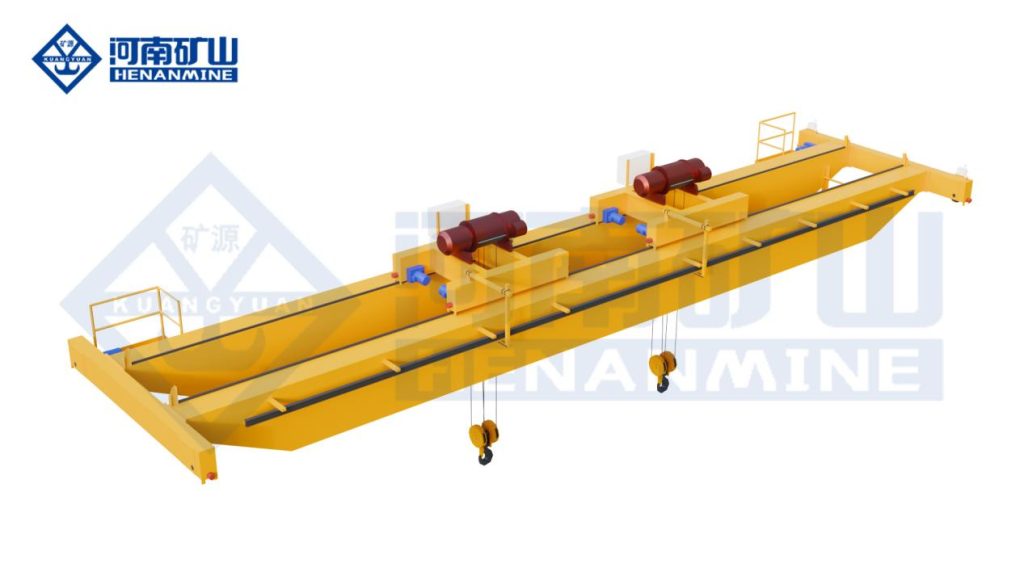
Double-Girder Bridge Crane — Suitable for Lifting Long and Eccentrically Loaded Workpieces
Choosing the right double-trolley hoist overhead crane can perfectly solve the hoisting challenges of long workpieces and eccentrically loaded materials, greatly improve workshop transfer efficiency, avoid repeated equipment purchases and save factory investment at the same time. Many purchasers confuse the structures of single-trolley and double-trolley cranes and overlook synchronous control parameters during model selection, resulting in tilted hoisting and idle equipment. This article thoroughly breaks down the types of double-trolley hoist overhead travelling cranes, core model selection indicators, and parameters required for quotations, helping you find a lifting solution fully adapted to your workshop working conditions in one stop.
What is a double trolley overhead crane with hoist?
The LHE model double-trolley hoist overhead crane, also commonly referred to as a double-hoist double-girder travelling crane, is equipped with two independently travelling lifting trolleys mounted on either a single-girder or double-girder bridge frame, and each trolley is fitted with a complete electric hoist lifting mechanism.
The equipment supports two operation modes: the two trolleys can separately lift small workpieces independently; or they can perform synchronous linkage via PLC frequency conversion to collaboratively hoist extra-long workpieces with unbalanced center of gravity at two lifting points. Different from ordinary single-hoist travelling cranes and main-and-auxiliary hook cranes, it is special-purpose lifting equipment for long steel materials, large molds and wind power components.
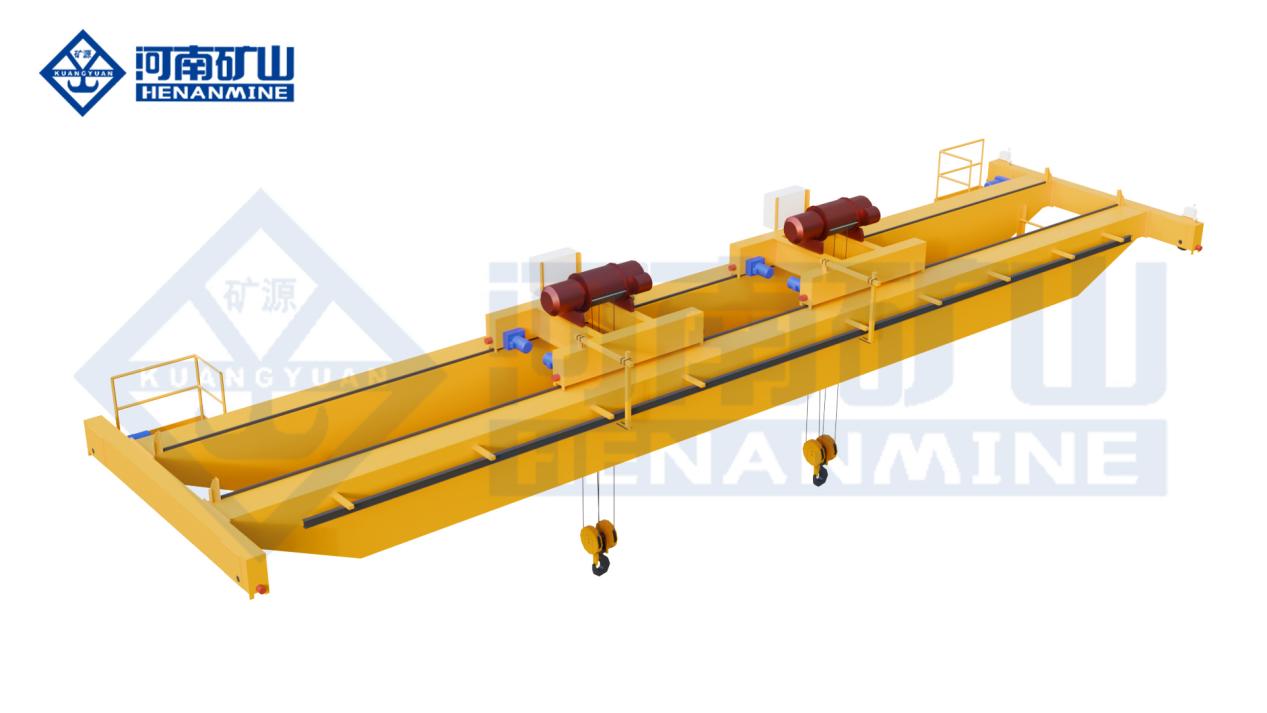

Core Functions of Cranes Equipped with Two Electric Hoist Trolleys
The cable tray is equipped with two sets of electric hoists, whose core function is to realize two-point synchronous lifting. When hoisting long steel sections and large molds, the workpieces can be kept horizontal to prevent skewing and deformation. The two sets of hoists can work together to bear heavy and long workpieces, or operate independently separately. A single unit meets two types of transportation requirements, eliminating the cost of purchasing additional cranes. Meanwhile, the load is shared by the two hoists, reducing the bearing pressure on the factory tracks and roof steel beams. If one set breaks down, the other can still handle the lifting of small workpieces to minimize workshop downtime losses. In addition, the two trolleys can freely adjust the hook spacing to fit workpieces of different lengths.
Two Main Types of Common Double Trolley Hoist Cranes
1) Independent Separate Double Trolley Hoist
The two trolleys have no rigid connection and can move freely on the main beam. The distance between lifting hooks can be adjusted arbitrarily to fit workpieces of unfixed lengths, featuring the highest versatility and serving as the mainstream choice for workshops.

Synchronized fixed double trolley hoist
Dual trolleys equipped with synchronous limiting brackets feature fixed hook spacing and superior synchronization accuracy, widely used for mass hoisting of standardized assembly lines and fixed-length profiles.
Supporting sub-models: indoor standard double girder type, low-headroom type for low-rise workshops, suspended dual-trolley hoist overhead cranes


What workshop scenarios are suitable for double trolley hoist cranes?
- Steel Structure Processing Plant: Synchronous hoisting of long H-beams, channel steels and metal frames
- Mold Manufacturing Workshop: Transfer of large combined molds and eccentric castings
- New Energy Industry: Hoisting of wind power main shafts and long battery modules
- Mechanical Assembly Factory: Installation of machine tool beds and large racks
- Vehicle Manufacturing: Lifting of complete vehicle chassis and extra-long components
- Not Applicable: Narrow single workstations, single hoisting of only small parts, outdoor corrosive working conditions.
Core Factors Affecting the Quotation of Double Trolley Hoist Traveling Mechanism
- Tonnage Configuration: The higher the tonnage, the higher the material costs for the main girder, trolley and hoist;
- Synchronous Electric Control System: Variable-frequency PLC synchronous control commands a higher premium than ordinary electric control systems and delivers smoother operation;
- Structural Form: Independently arranged double trolleys cost more than fixed-spacing double trolleys;
- Additional Configurations: Anti-sway device, overload protection, remote monitoring, maintenance walkway;
- Plant Adaptation and Renovation: Underslung cranes require roof reinforcement, leading to additional civil engineering costs;
- Export Qualifications: Special equipment certifications including CE and ISO will incur extra supporting inspection fees.
What information needs to be provided to obtain an accurate quotation?
- Matching tonnage of double hoists (e.g. 5 tons + 5 tons);
- Clear span of the workshop building and total longitudinal travel length of the trolley;
- Maximum length of workpieces and normal single-piece weight;
- Effective lifting height of the workshop and floor height of the plant building;
- Installation type: floor-mounted double-girder type / underslung low-headroom type;
- Daily service hours and operation frequency;
- Whether synchronous frequency conversion, wireless remote control and export certifications are required.
Frequently Asked Questions (FAQs)
What is the difference between a double trolley hoist and a single trolley double hoist?
The two hoists of the double trolley operate completely independently with an adjustable hook spacing; the hook distance of the single trolley double hoist is fixed, making it suitable for only a narrow range of scenarios.
Can the two trolleys lift two separate goods simultaneously and independently?
An independent operation mode is supported. One trolley can lift small parts while the other hoists other workpieces synchronously to boost workshop production capacity.
What should be done if workpieces tilt easily during lifting with a double trolley overhead crane?
It is equipped with a standard PLC variable-frequency synchronization system that controls lifting errors within ±5mm. Combined with two-point balanced lifting, twisting and tilting can be prevented.
Can double trolley hoist cranes be installed in old factories with low ceiling heights?
Low-headroom suspended double trolley models are available. No ground upright columns are required; only load-bearing verification of roof steel beams is needed.
What is the service life of the complete machine with regular proper maintenance?
With standardized monthly lubrication and periodic inspections, the complete machine can operate stably for 10 to 20 years.
Can this product be used for overseas export projects?
A full set of certifications for lifting equipment including CE, ISO and TSG can be provided, meeting the requirements of markets in the Middle East, Southeast Asia and Europe.