


Electric Hoists
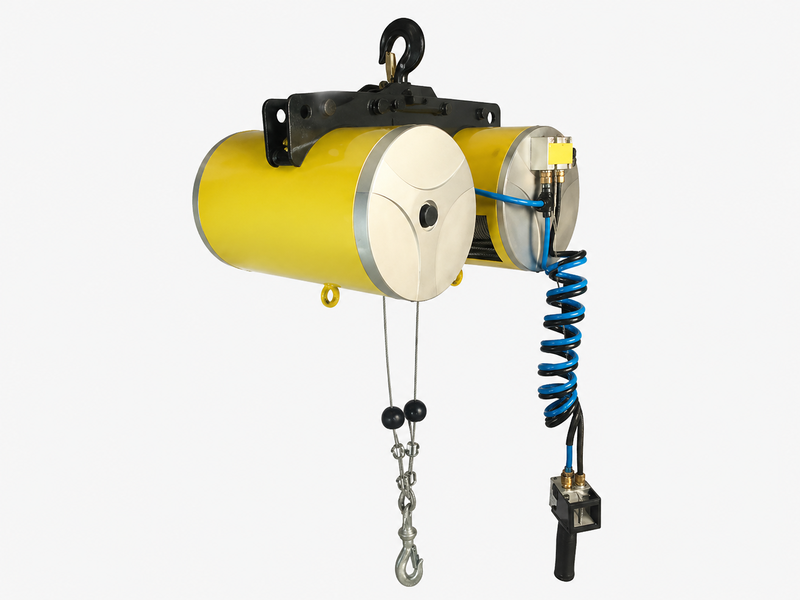
Air Pneumatic Hoist
Air Pneumatic Hoist is a compressed-air powered lifting solution for precise, safe, and efficient material handling in harsh or electricity-sensitive working environments.
Product Overview
Air Pneumatic Hoist, also known as air hoist, is powered by compressed air and designed for lifting, lowering, balancing, positioning, and assisted assembly of heavy objects. It is suitable for workplaces that require non-sparking operation, smooth speed control, frequent lifting cycles, and reliable performance in harsh or electricity-sensitive environments.
The hoist uses compressed air as the power source. Through the transmission mechanism, piston system, wire rope arrangement, and control handle, the operator can control the lifting and lowering movement of the load. Compared with conventional electric hoists, an air pneumatic hoist is suitable for applications where clean operation, fast response, variable speed control, and safe operation are important.
Air Pneumatic Hoist Models
This product includes four specialized designs: Single-Line Wire Rope Air Pneumatic Hoist, Wire Rope Air Pneumatic Hoist with Sheave Block, Parallel Wire Rope Air Pneumatic Hoist, and Parallel Wire Rope Air Pneumatic Hoist with Sheave Block. The single-line model is compact and suitable for general lifting. The sheave block design can increase lifting capacity while reducing travelling distance. The parallel wire rope design can improve lifting capacity without affecting travelling distance, while the parallel model with sheave block is used when higher lifting capacity is required.
The main structure can include an ergonomic control handle, centrifugal brake, silent ball screw, steel wire rope, steel housing, engineering plastic reel, piston, suspension bracket, pneumatic valve, and hook or trolley suspension. The control handle allows lifting and lowering speed adjustment, while the centrifugal brake, air break protection, overload protection, and built-in braking functions help improve operational safety.
According to different installation conditions, the hoist can be supplied with fixed hook type, I-beam trolley type, or sliding trolley type suspension. It can be used for assembly lines, precision positioning, machine maintenance, industrial handling, and lifting work where compressed air is preferred over electric power. Final selection should confirm rated load, input air pressure, lifting stroke, lifting speed, suspension type, wire rope arrangement, control method, and working environment.
For related lifting equipment, you can also view Electric Hoists, Overhead Cranes, and Gantry Cranes. For hoist and machinery safety reference, you may check the ASME B30.16 Overhead Underhung and Stationary Hoists and ISO 12100 Safety of Machinery.
Technical Parameters
| Parameter | Single-Line Wire Rope Air Pneumatic Hoist | Wire Rope Air Pneumatic Hoist with Sheave Block | Parallel Wire Rope Air Pneumatic Hoist | Parallel Wire Rope Air Pneumatic Hoist with Sheave Block |
|---|---|---|---|---|
| Power Source | Compressed air | |||
| Lifting Capacity Range | 58kg-1100kg | |||
| Model Design | Single-line wire rope | Single-line wire rope with sheave block | Parallel wire rope | Parallel wire rope with sheave block |
| Capacity Feature | Basic lifting arrangement | Doubles lifting capacity and halves travelling distance | Lifts twice as much as single-line type without affecting travelling distance | Can reach four times the basic model capacity with additional dynamic pulleys |
| Standard Floating Mode | 400mm up and down | 200mm up and down | 400mm up and down | 200mm up and down |
| Protection Functions | Air break protection / Overload protection / Centrifugal brake | |||
| Speed Control | Infinitely variable speed control | |||
| Control Handle | Ergonomic control handle with adjustable lifting and lowering speed | |||
| Suspension Types | Fixed hook type / I-beam trolley type / Sliding trolley type | |||
| Main Components | Centrifugal brake, ball screw, suspension bracket, steel housing, pneumatic valve, piston, wire rope, control handle | |||
Key Features
Suitable for precision positioning, assisted assembly, and frequent lifting work
Four model designs available for different lifting capacity and travelling distance requirements
Air break protection helps prevent the load from falling when the air source is suddenly cut off
Overload protection helps prevent lifting beyond the rated load
Built-in centrifugal brake helps reduce sudden rapid lifting caused by misuse
Infinitely variable speed control for smooth lifting and lowering operation
Self-adaptive floating function supports gravity-free positioning and assisted assembly
Fixed hook type, I-beam trolley type, and sliding trolley type suspension available
Compact structure with low noise and clean operation
Customized Crane Solution
Air Pneumatic Hoist can be customized according to lifting capacity, lifting stroke, input air pressure, installation method, suspension type, wire rope arrangement, control requirement, and working environment.
Available customization includes single-line wire rope type, sheave block type, parallel wire rope type, parallel wire rope with sheave block type, fixed hook suspension, I-beam trolley suspension, sliding trolley suspension, control handle arrangement, lifting speed control, and floating function configuration.
- Customized rated load and lifting stroke
- Customized single-line or parallel wire rope arrangement
- Customized sheave block configuration for higher lifting capacity
- Customized fixed hook, I-beam trolley, or sliding trolley suspension
- Customized ergonomic control handle and speed adjustment
- Customized floating function for precision positioning
- Customized configuration for assembly, maintenance, and harsh working environments
Before quotation, please confirm rated load, required lifting stroke, input air pressure, working frequency, installation beam type, suspension method, lifting speed requirement, and whether floating positioning is required.
Get a Factory-Based Quotation
Send your capacity, span, lifting height and working site. Our team will help check the suitable crane type and provide a project-based quotation.
Parameter Check
We review capacity, span, lifting height, duty and site conditions before recommending a configuration.
Factory Configuration
Quotation is based on crane structure, hoist or trolley type, control system and safety options.
Export Support
Discuss packing, delivery reference, drawings and project communication for overseas orders.
What We Need
- Capacity, span, lifting height and working duty.
- Workshop or yard layout, runway condition and power supply.
- Working environment, daily operation time and special requirements.
- Destination country, quantity and drawings or photos if available.
How It Works
- Send parametersShare the project data you already know.
- Confirm configurationWe check crane type and key technical scope.
- Receive quotationGet factory-based price and selection support.